What’s the Difference Between Gunite and Shotcrete for Pools?
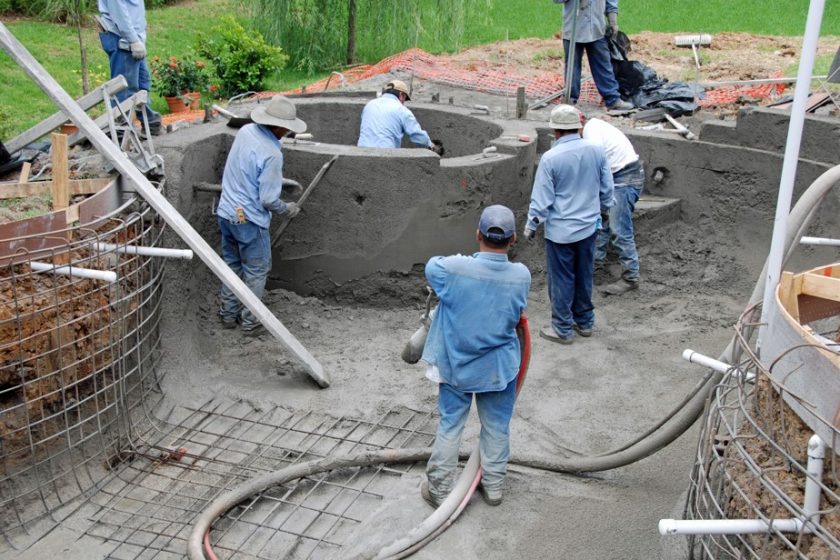
Gunite is dry-mix shotcrete. Shotcrete is the umbrella term for concrete that is sprayed into place at high velocity through a hose, and it comes in two versions: dry-mix (gunite), where water is added at the nozzle, and wet-mix, where the concrete arrives already mixed. Both build concrete pool shells, and an article in the American Shotcrete Association’s Shotcrete magazine says both “work exceptionally well when correctly placed with a well-trained crew.”
Key takeaways
- Gunite and shotcrete are two ways of placing concrete. “Gunite” is the original trade name for the dry-mix process.
- Dry-mix adds water at the nozzle. Wet-mix pumps premixed concrete and adds air at the nozzle.
- Neither process is automatically stronger. The American Shotcrete Association sets a 4,000 psi minimum for pool shells, and good shotcrete of either type typically reaches 4,500 to 9,000 psi or more.
- A gunite pool is a concrete pool. The difference from “concrete” pools is how the concrete gets placed.
- The shell needs at least 7 days of wet curing, and plastering industry groups recommend moist curing for 28 days before a plaster finish goes on.
What this guide covers
- What is gunite?
- What is shotcrete?
- Gunite vs shotcrete at a glance
- Which is stronger, gunite or shotcrete?
- How do rebound, cracking, and finish compare?
- What about cost, crew skill, and scheduling?
- Gunite vs concrete: is a gunite pool a concrete pool?
- How long after gunite can you plaster?
- Which should you choose for your pool?
- About Hobert Pools & Spas
- Frequently Asked Questions
Updated September 2026
What is gunite?
Gunite is concrete placed by the dry-mix shotcrete process. A dry blend of sand and cement travels through a hose to the nozzle, where the crew injects water just before the material hits the steel and soil. The American Shotcrete Association (ASA) defines it this way: “Gunite refers only to the dry-mix process in which the dry cementitious mixture is blown through a hose to the nozzle, where the water is injected immediately prior to application.“
The name is a leftover from history. “Gunite” was the trade name for the dry sand and cement mix shot from the Cement Gun Company’s equipment. When the American Concrete Institute (ACI) began writing standards for the process in 1951, it adopted the neutral term “shotcrete” instead. Many pool builders still say “gunite,” and some use it loosely for any sprayed concrete pool.
What is shotcrete?
Shotcrete is the general name for concrete that is conveyed through a hose and projected at high velocity onto a surface. The ASA’s terminology statement, built on ACI definitions, calls it “a concrete-placing process” that “produces high-quality dense concrete with a low water-cementitious material ratio (w/cm), low permeability, and a high cementitious material content.” The material strikes the surface at an ideal impact velocity of 350 to 400 feet per second, which compacts it as it lands.
So gunite is one kind of shotcrete. When people compare “gunite vs shotcrete” in a pool conversation, they almost always mean dry-mix vs wet-mix.
How do dry-mix and wet-mix work?
- Dry-mix (gunite): dry materials, “often just a coarse sand and cement mixture,” go through the hose. The nozzleman adds most of the water at the nozzle and controls the consistency by hand. Many dry-mix crews batch on site from a volumetric mixer truck.
- Wet-mix shotcrete: the concrete, water included, is fully mixed before it enters the hose. It usually arrives as ready-mixed concrete with coarse sand, small stone of 3/8 inch or less, and cement. A pump pushes it down the line and compressed air at the nozzle shoots it into place.
Gunite vs shotcrete at a glance
This table summarizes how the two processes compare for pool shells, drawn from ASA guidance and an ASA article written by two pool shotcrete contractors (Guarino and Oakes, Shotcrete, Summer 2018).
| Factor | Gunite (dry-mix) | Wet-mix shotcrete |
|---|---|---|
| Where water is added | At the nozzle | Before pumping, at the plant or mixer |
| Typical water-cement ratio | 0.35 to 0.40 | 0.40 to 0.45 |
| Strength | Meets the 4,000 psi pool minimum; well-made shotcrete of either type typically reaches 4,500 to 9,000+ psi at 28 days | Meets the 4,000 psi pool minimum; well-made shotcrete of either type typically reaches 4,500 to 9,000+ psi at 28 days |
| Rebound | Typically more | Typically less |
| Finishing detail work | Easier; sand and cement mix with no coarse stone | Harder; coarse stone in the mix |
| Walking on fresh material | Leaves little more than a footprint | Can disturb the concrete and the steel below |
| Production speed | Lower | Can roughly double output on large jobs |
| Time limits | Dry materials can wait until the crew is ready | Usually placed within 90 minutes of batching |
| Crew skill | Nozzleman controls the water, so more skill is needed | Heavier hoses; crew must resist adding water to pump |
| Best fit, per the ASA article | Pools under about 1,000 sq ft of water surface, detailed pools, tight yards | Large pools, heavy steel, multi-day shoots |
Which is stronger, gunite or shotcrete?
Neither one wins on strength by default. The ASA article puts it plainly: “Strength is not an argument for one shotcrete process over the other, as both, with the proper concrete mixture designs, can produce strong, functionally impermeable concrete shells.” A 5,000 psi dry-mix shell and a 5,000 psi wet-mix shell are the same strength.
What matters is the number the shell actually reaches. The ASA’s pool strength position statement sets a 4,000 psi minimum 28-day compressive strength for pool concrete, matching the ACI 318 building code requirement for concrete in contact with water where low permeability is required. It adds that good shotcrete typically produces “28-day compressive strengths ranging from 4500 to 9000 psi (31 to 62 MPa) or more.”
Dry-mix does have a built-in edge on water content. It typically runs a water-cement ratio of 0.35 to 0.40, compared with 0.40 to 0.45 for wet-mix, and less water generally means stronger, less permeable concrete. The ASA says that because of the “lower w/cm inherent in dry-mix (gunite) shotcrete,” its strengths “will normally far exceed” the 4,000 psi minimum.
Wet-mix has one well-known weak spot. If a truck of concrete stiffens while it waits, crews sometimes add water so it will pump. The ASA article calls this “a common practice in the pool industry” that can push the water-cement ratio above 0.50, which “reduces the strength of the shell and increases the permeability” and raises the chance of shrinkage. A careful wet-mix crew uses water-reducing admixtures instead.
How do rebound, cracking, and finish compare?
Dry-mix usually produces more rebound, both processes can crack, and dry-mix is easier to finish in detailed areas.
Rebound
Rebound is material that bounces off the surface during shooting. It matters because rebound “has inadequate cementitious content as compared to the original shotcrete,” according to the ASA terminology statement. If it gets left in the pool or shot back into the shell, it creates weak zones. The ASA article notes that “the wet-mix process typically has less rebound than dry-mix,” but also that “depending on the nozzleman, a job can experience more or less rebound,” whichever process is used. A good crew uses a blowpipe to clear rebound and removes it from the floor and cove.
Cracking and shrinkage
No concrete pool shell is immune to shrinkage. The ASA article says shrinkage “takes place in all concrete whether cast or shotcreted.” Dry-mix’s lower water content “can reduce shrinkage cracking,” and extra water added to wet-mix increases it. The same article lists the usual causes of pool shell cracks as inadequate steel reinforcement, poor soil, poor curing, seasonal temperature swings, shrinkage, and rebound left in the pool, and concludes that “with proper attention to shrinkage, cracking is typically not an argument for one process over the other.”
Finish
The shell’s surface is a base for the interior finish, so neither process needs special paint. A common rod-cut finish on shotcrete leaves a rough texture that the ASA describes as “a great surface to later bond a tile or marcite plaster finish.” Dry-mix has a practical advantage in detailed work: a mix of cement and sand with no coarse stone is easier to place and shape. With wet-mix, “coarse stone in the mixture makes it more difficult on the finishers to achieve required finishes.”
What about cost, crew skill, and scheduling?
Crew skill matters more than the process. Cost and scheduling differences mostly show up on the contractor’s side, and the right choice depends on the size of the pool and the site.
Cost
The published comparisons from the ASA talk about equipment cost for the shotcrete contractor rather than a price difference for the homeowner. A full dry-mix operation with volumetric mixers can cost “15 to 20 times (or greater) than that of a wet-mix setup” to start, while wet-mix has a “low start-up cost.” For your project, the price of the shell is one part of the total, which depends mostly on size, design, features, and site conditions. Our 2026 DFW pool cost guide covers those factors.
Crew skill
Because the water is controlled at the nozzle, “dry-mix requires a more skilled nozzleman to place the material at the proper consistency,” the ASA article says. Wet-mix brings its own demands: hoses that carry about 10 times the internal pressure and are heavier to handle, plus the discipline to avoid watering down the mix. The ASA’s contractor qualifications statement says “the nozzleman must be well-versed in shooting techniques, including proper air, water, and mixture flow,” and the ASA recommends using an ACI-certified shotcrete nozzleman. When you interview builders, ask who shoots the shell and whether the nozzleman holds that certification.
Scheduling
Dry-mix is flexible on timing. The dry materials in a volumetric mixer “can sit as long as needed until the crew is ready to start shotcreting again,” and pools under about 1,000 square feet of water surface can typically be shot in a day. Wet-mix is faster on big jobs and “can double the production rate,” but unless the mix uses a retarder, “the batched concrete needs to be placed within 90 minutes of batching,” so the crew depends on the ready-mix supplier’s delivery schedule. Dry-mix cleanup is also simpler in tight backyards because there is no concrete truck washout to manage.
Planning a pool project in North Texas? Hobert Pools & Spas offers a free design consultation. Call the Murphy showroom at (972) 690-8118 or the McLendon-Chisholm showroom at (972) 772-3358, or start online.
Gunite vs concrete: is a gunite pool a concrete pool?
Yes. A gunite pool is a concrete pool. As the ASA article explains, “Gunite and shotcrete are not materials, but rather are placement methods for pneumatically placing (shooting) concrete materials at high velocity.” When someone compares “gunite vs concrete,” the real comparison is sprayed concrete against concrete cast in forms.
For pool shells, shotcrete has clear advantages over cast-in-place concrete, according to an ASA article on the topic:
- Only one side of a wall needs forming, and the forms are much lighter, so free-form shapes are practical.
- The shell can be built as one monolithic piece with no construction joints between floor and walls.
- Shotcrete “commonly gains strength much faster than CIP concrete,” and “it is not uncommon to see shotcrete hit the specified 28-day compressive strength in 7 days.”
The same author notes that for larger projects shotcrete is not substantially cheaper than cast-in-place, but it builds a durable, strong pool faster. If your real question is concrete versus a factory-made shell, see our guide to gunite vs fiberglass pools in Texas.
How long after gunite can you plaster?
Wet cure the gunite for at least 7 days, and plan on about 28 days of moist curing before a cementitious plaster finish goes on. The ASA’s curing position statement for swimming pools says ACI and ASA “typically require that curing remains in place for a minimum of 7 days,” and that “for shotcrete swimming pool structures that are to receive a cementitious finish coating, ACI Committee 524, Plastering, and the National Plasterers Council (NPC) recommend that moist curing be continued for 28 days.”
The ASA’s recommended schedule:
- Days 1 to 7: keep the shell continuously moist, soaking the surface three to five times a day or more, usually with a garden hose.
- Days 7 to 28: wet all exposed surfaces at least once a day.
- After day 28: wet the shell once or twice a week until the interior finish is applied and the pool is filled.
The timing matters because roughly 70% of cement hydration happens in the first 7 days and about 85% in the first 28, according to the same statement. Extending wet curing from 3 days to 7 can cut surface shrinkage cracking by 10 to 20%. Longer curing also lowers how fast the shell soaks water out of fresh plaster, which helps the plaster bond and finish evenly. If a curing compound was sprayed on instead of water, the ASA says it must be removed before plaster or tile, because the film acts as a bond breaker.
In practice the shell is rarely plastered right away anyway. In practice the shell is rarely plastered right away anyway. In the Hobert Pools construction process, plastering is the last construction step. It comes after gas and electric, tile and coping, decking, and outdoor living work.
Which should you choose for your pool?
Choose the builder and crew first, then the process. The ASA article’s conclusion is that both dry-mix and wet-mix, “when using quality materials, well-maintained and properly sized equipment, and placed by experienced shotcrete crews, are great for creating high-quality, durable, watertight swimming pools.” In the authors’ experience, dry-mix excels on pools under about 1,000 square feet of water surface, highly detailed pools, and tight backyards, while wet-mix shines on large pools with heavy steel that take more than a day to shoot.
Questions worth asking any builder:
- Is the shell dry-mix or wet-mix, and why for this pool?
- Is the nozzleman ACI certified?
- What compressive strength is specified, and is it at least 4,000 psi?
- How is rebound removed, and who waters the shell during curing?
- How long will the shell cure before plaster?
Hobert Pools & Spas specializes in custom gunite pools. In our build process, gunite is applied under high pressure over the steel rebar framework, bonding tightly to the steel, and the shell cures before the rest of the work moves ahead. For more on why homeowners in North Texas pick this method, read the benefits of a gunite pool.
Planning a pool project in North Texas? Hobert Pools & Spas offers a free design consultation. Call the Murphy showroom at (972) 690-8118 or the McLendon-Chisholm showroom at (972) 772-3358, or start online.
About Hobert Pools & Spas
Hobert Pools & Spas is a family-owned custom gunite pool builder in North Texas, founded in 1975 by Hobert Murphree. From showrooms in Murphy and McLendon-Chisholm, the team designs and builds new pools and spas and handles pool renovations, outdoor living, and pool service. To talk through your project, contact us to schedule a free design consultation.
Frequently Asked Questions
Is gunite the same as shotcrete?
Gunite is one type of shotcrete. Shotcrete is the general term for concrete sprayed into place at high velocity, and gunite is the original trade name for the dry-mix version, where water is added at the nozzle. The other version, wet-mix shotcrete, arrives already mixed with water.
Which is stronger, gunite or shotcrete?
Neither is automatically stronger. Shotcrete contractors writing for the American Shotcrete Association say strength is not an argument for one process over the other when the mix design is correct. The association sets a 4,000 psi minimum 28-day compressive strength for pool shells, and good shotcrete of either type typically reaches 4,500 to 9,000 psi or more.
Is a gunite pool a concrete pool?
Yes. Gunite and shotcrete are methods of placing concrete, so a gunite pool shell is made of concrete. The difference from a cast-in-place concrete pool is that the concrete is sprayed onto steel and soil instead of poured into forms.
How long after gunite can you plaster?
The American Shotcrete Association calls for at least 7 days of wet curing, and ACI Committee 524 and the National Plasterers Council recommend moist curing for 28 days before a cementitious finish such as plaster is applied. Keep the shell wet several times a day for the first week, then at least once a day through day 28.
Does gunite crack less than shotcrete?
Not by default. All concrete shrinks, whether it is cast or sprayed. Dry-mix gunite uses less water, which can reduce shrinkage cracking, but an article in the American Shotcrete Association’s magazine says that with proper attention to shrinkage, cracking is typically not an argument for one process over the other. Steel, soil, curing, and rebound removal matter more.
What kind of pools does Hobert Pools build?
Hobert Pools & Spas specializes in custom gunite pools designed to fit each backyard, including traditional, modern, and infinity styles. Construction typically takes 8 to 12 weeks from excavation to completion.


